This is the rigid box half of our dieline guide. Folding cartons, mailers and bags are one printed sheet; a rigid box (硬盒) is greyboard wrapped in printed paper, so its dieline arrives as a set of sheets and you need to know which of them you actually design.
The line colours are the same as the folding carton guide: black cuts, green folds. Read that guide first if the terms are new, then come back here for the four rigid styles.
The three layers of every rigid box
- Wrap paper 面紙
- The printed sheet glued around the greyboard. This is your main design surface. Its edges fold over the board and inside (反折進去的地方): bleed there, no key artwork.
- Liner 內襯紙
- A flat sheet glued inside the lid and base after wrapping. Plain by default; print it if you want colour or a message on opening.
- Greyboard 灰板
- The 1.5 to 2.5 mm board that gives the box its rigidity. The dieline shows it so you understand the structure; it is marked 無須設計 and never printed.
- Glue flap 黏位
- On sleeves and tray wraps, the strips that glue under another panel. Hidden; leave them unprinted or flat colour.
Text direction: side panels are labelled the way they will finally face, often upside down on the sheet. Design each panel in the direction its label reads.
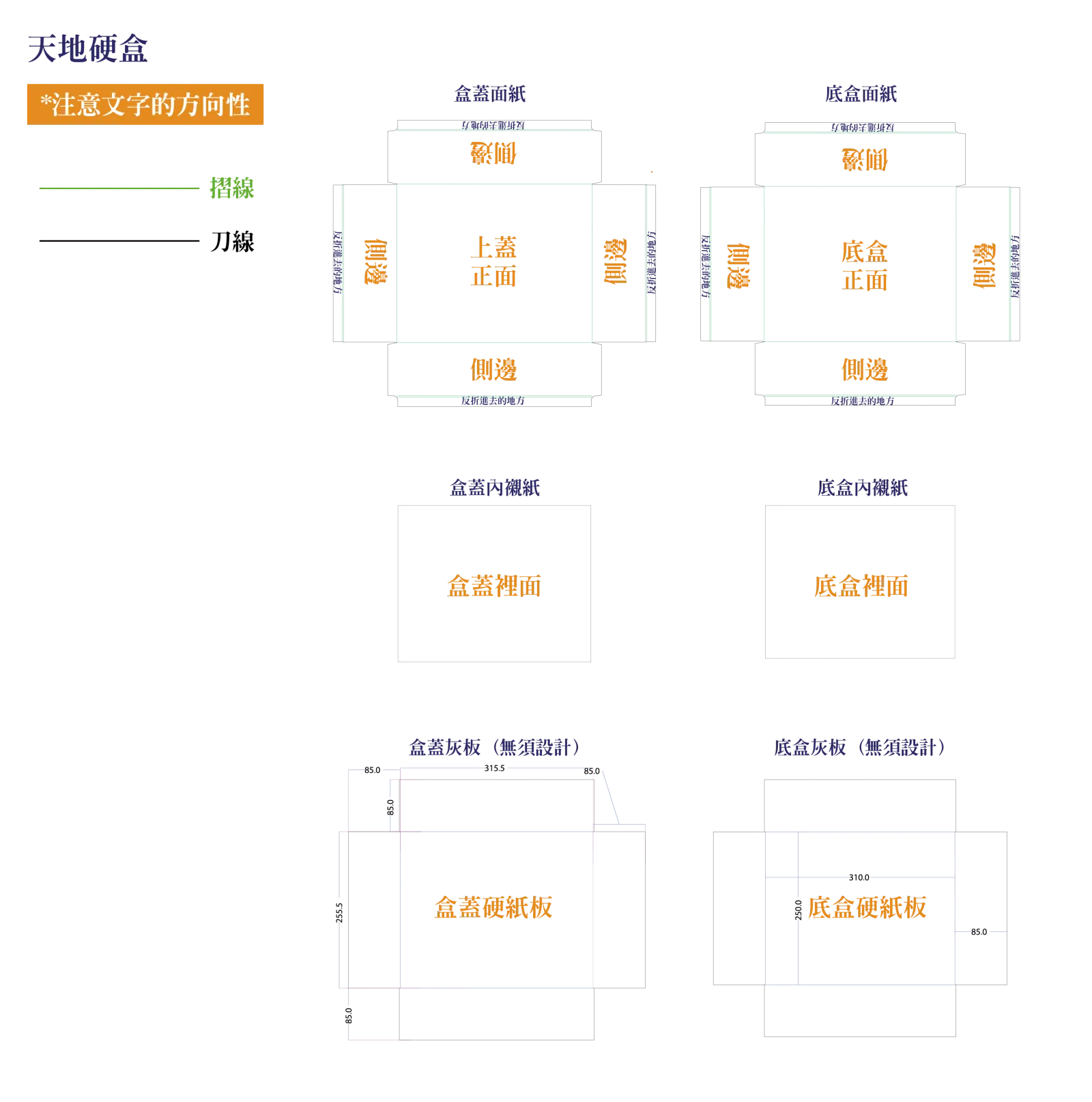
Lid-and-base rigid box (天地硬盒), 12 sheets
Two parts, lid and base, each drawn as wrap paper, liner and greyboard. The lid wrap has the top face and four sides, each side with a turn-in strip that folds inside; the base wrap is the same layout. The two liners are flat rectangles that cover the inside of the lid and the base.
The two greyboard drawings carry the real dimensions (this sample is 315.5 x 255.5 mm with 85 mm sides) so you can check the box size, but nothing on them is printed.
Tip:With a full-depth lid the base sides are hidden when closed; with a shallow lid they show. Ask which you are ordering before you design the base sides.
Drawer rigid box (抽屜硬盒), 11 sheets
The sleeve wrap is a strip of back, top, front and bottom with a closed end panel (底部) and glue flaps down both sides. The inner box wrap has the box front, four sides with glue flaps, and a ribbon-pull slot (絲帶孔) on one side. Add one liner for the inner box, plus a greyboard drawing for each part.
The sleeve liner is not drawn because the sleeve is only seen from outside; the inner box liner is what shows when the drawer is pulled.
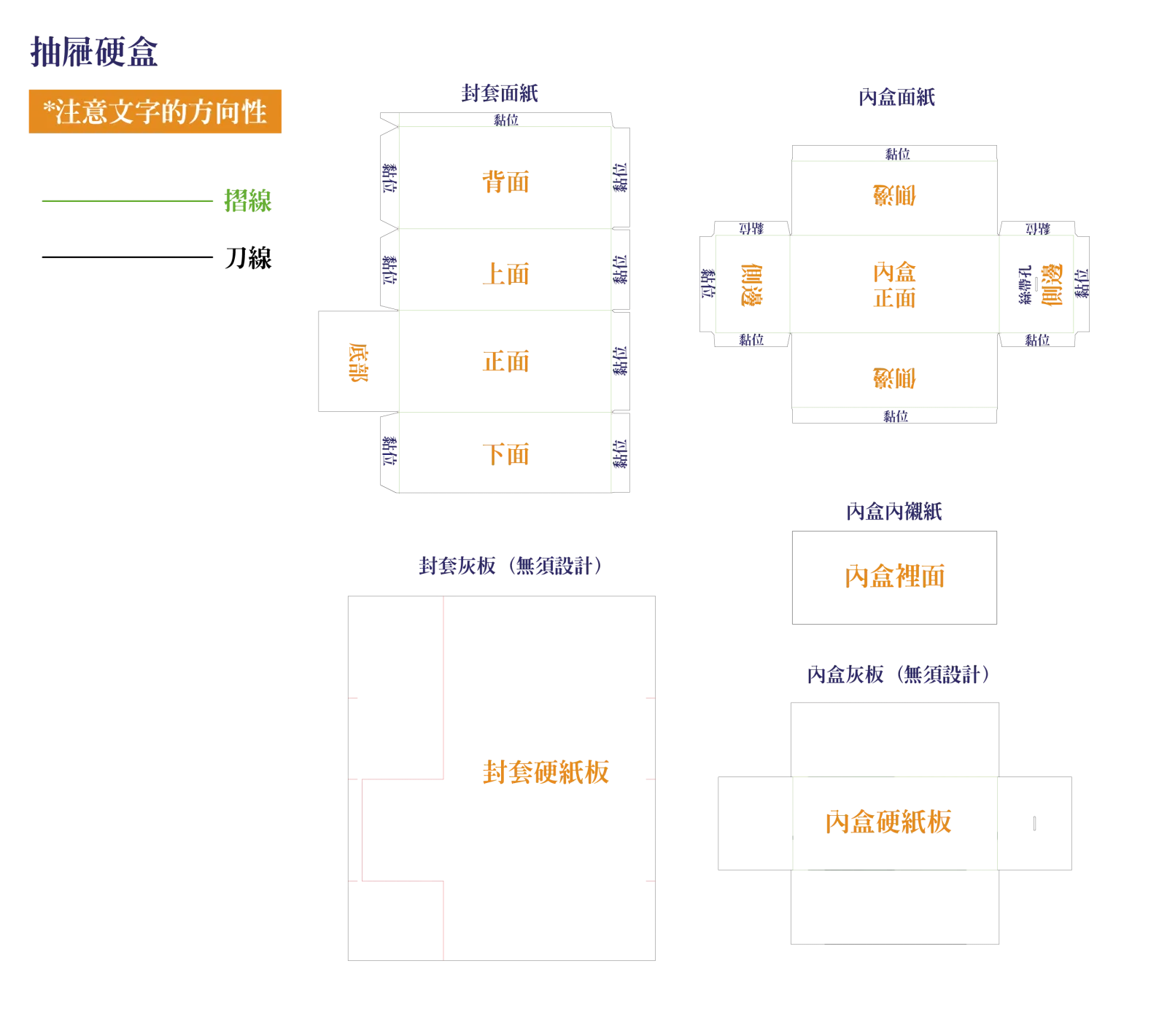
Tip:The ribbon-slot side is the pull side. The inner box front next to it is the first thing seen as the drawer opens: a good place for one line of text.
Matchbox rigid box (火柴硬盒), 10 sheets
Like the drawer box but the sleeve is open at both ends, so its wrap is just back, top, front and bottom with glue flaps on both sides. The tray wrap has the base face and four sides; the tray gets a liner and both parts get a greyboard drawing.
On the sheet the sleeve back and top are upside down relative to the front: that is how they will face once the strip is wrapped, so design them that way.
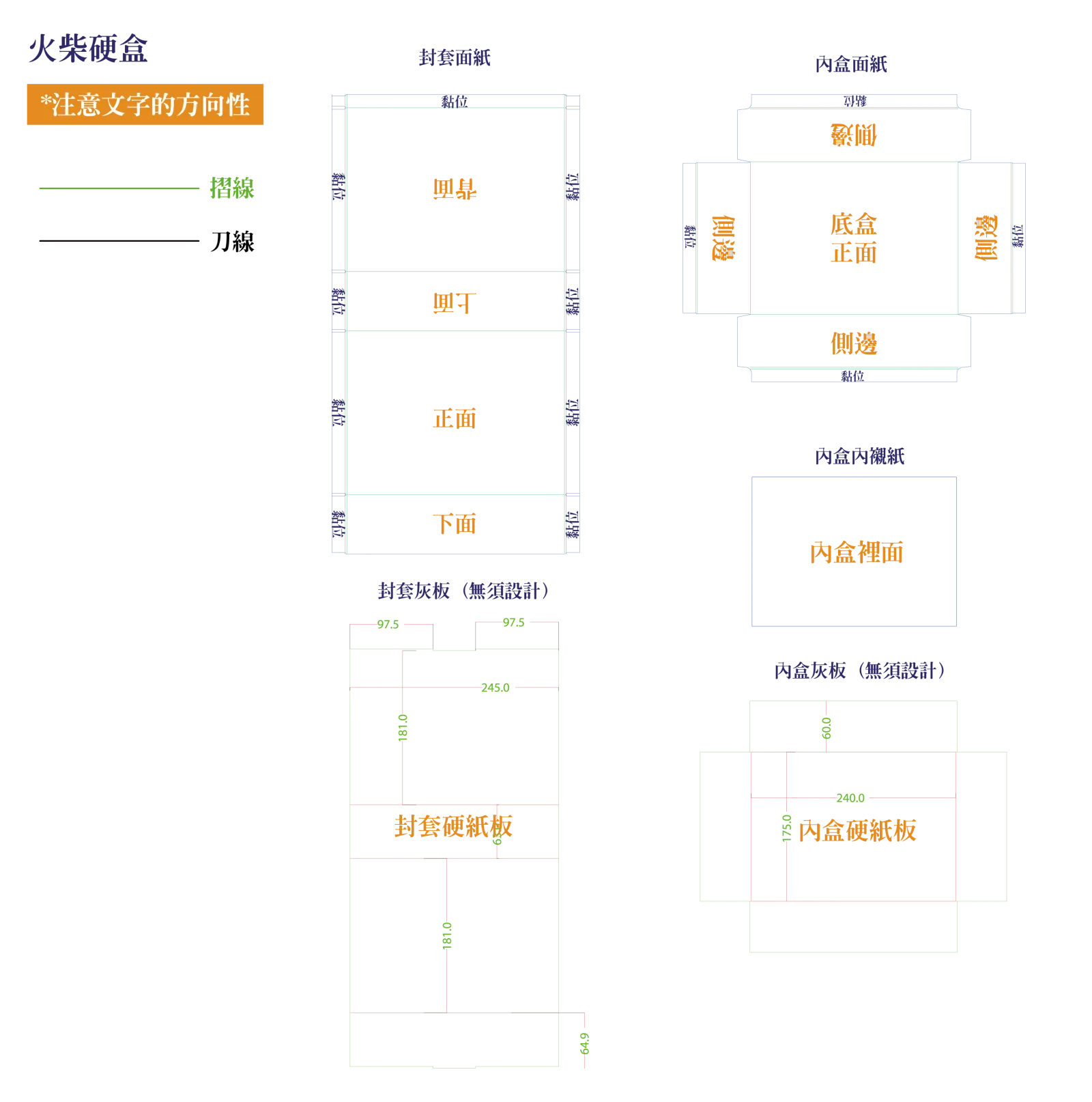
Tip:The tray shows at both open ends, so its two short sides are visible even when closed: give them the brand colour, not a blank.
Magnetic book-style rigid box (磁石書型硬盒), 12 sheets
The outer wrap runs back, spine (上面), front and then the closing flap (揭蓋位) where the magnets sit. The inner box wrap is a base face with four sides. Because the box opens like a book, the outer liner is drawn too: it covers the inside of the flap and the front, and it is visible every time the box opens.
Add the inner box liner and two greyboard drawings and you have 12 sheets: the largest set of the four, but only four of them carry artwork.
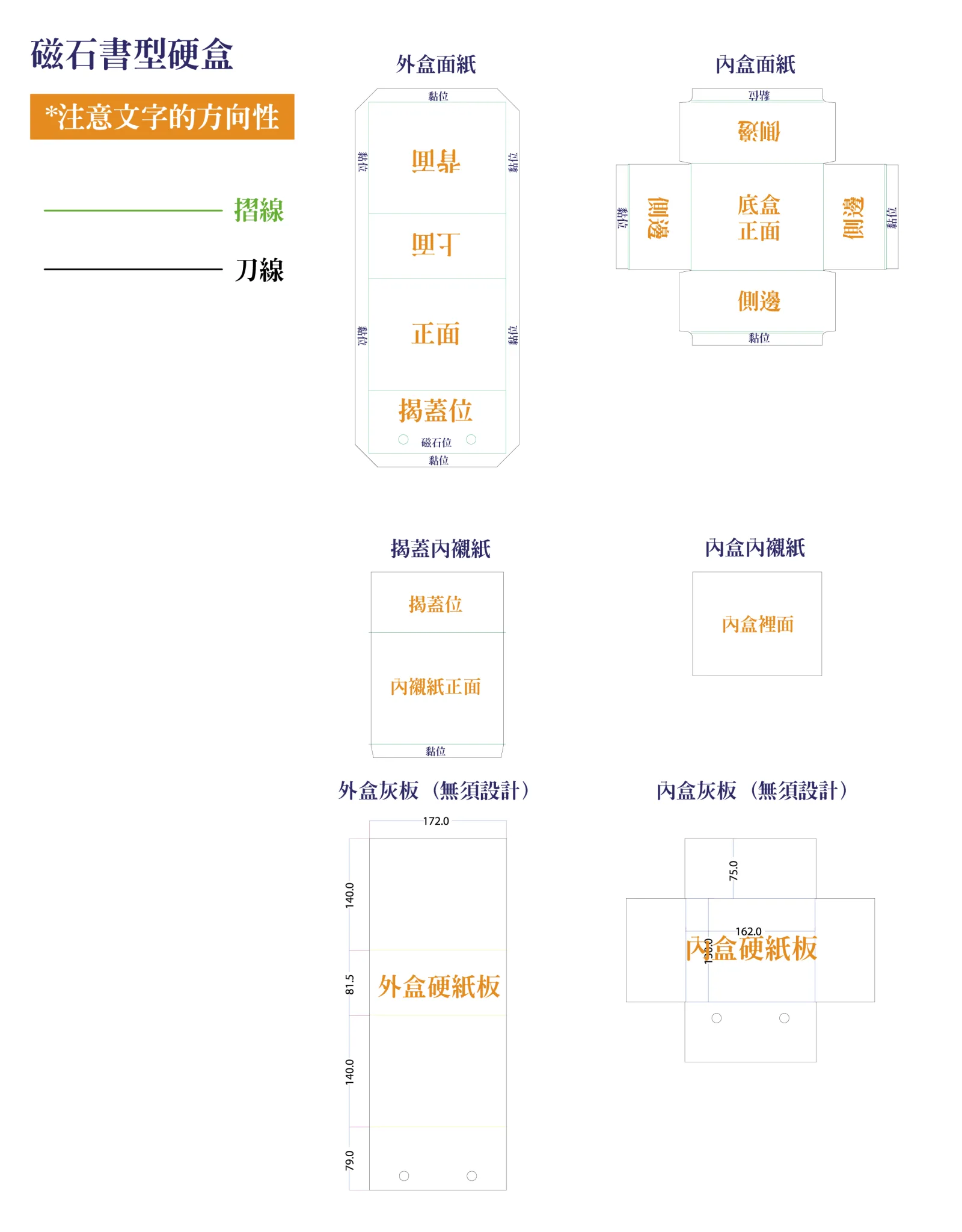
Tip:The flap face is the cover of the book: it is where the logo goes. The spine reads sideways on the shelf, so set any spine text to run top to bottom.
Rigid box dieline questions
How is a rigid box dieline different from a folding carton dieline?+
A folding carton is one printed sheet that folds into the box, so the dieline is one drawing. A rigid box is greyboard wrapped in printed paper and lined inside, so the dieline is a set: wrap paper, liner and greyboard for each part. Only the wrap paper and liner are yours to design, and the wrap paper has turn-ins instead of glue flaps.
Do I have to print the liner?+
No. A plain white or black liner is standard. Printing it costs a little more but it is the first surface the customer sees when the lid lifts, so a colour, a pattern or one line of text there does more for the unboxing than anything on the outside.
Does the greyboard thickness change my artwork?+
Yes, which is why you should never scale a dieline yourself. Board of 1.5 to 2.5 mm changes the wrap paper dimensions and the turn-in width. Confirm the box size and board on the product page and we send the wrap paper and liner dielines calculated for that exact board.
Do I need to mark the magnet positions on a magnetic box?+
No. The magnets are set into the greyboard during assembly and sit invisibly under the wrap paper. The dieline marks their position only so you know where the flap closes; your artwork does not change.
Next step: get the rigid box dieline for your size and board
Choose the rigid style on its product page, enter the size and see the price instantly. Once confirmed we send the wrap paper and liner dielines calculated for that board thickness, free, as an AI file. If you would like help with the artwork itself, say so at quote stage.